





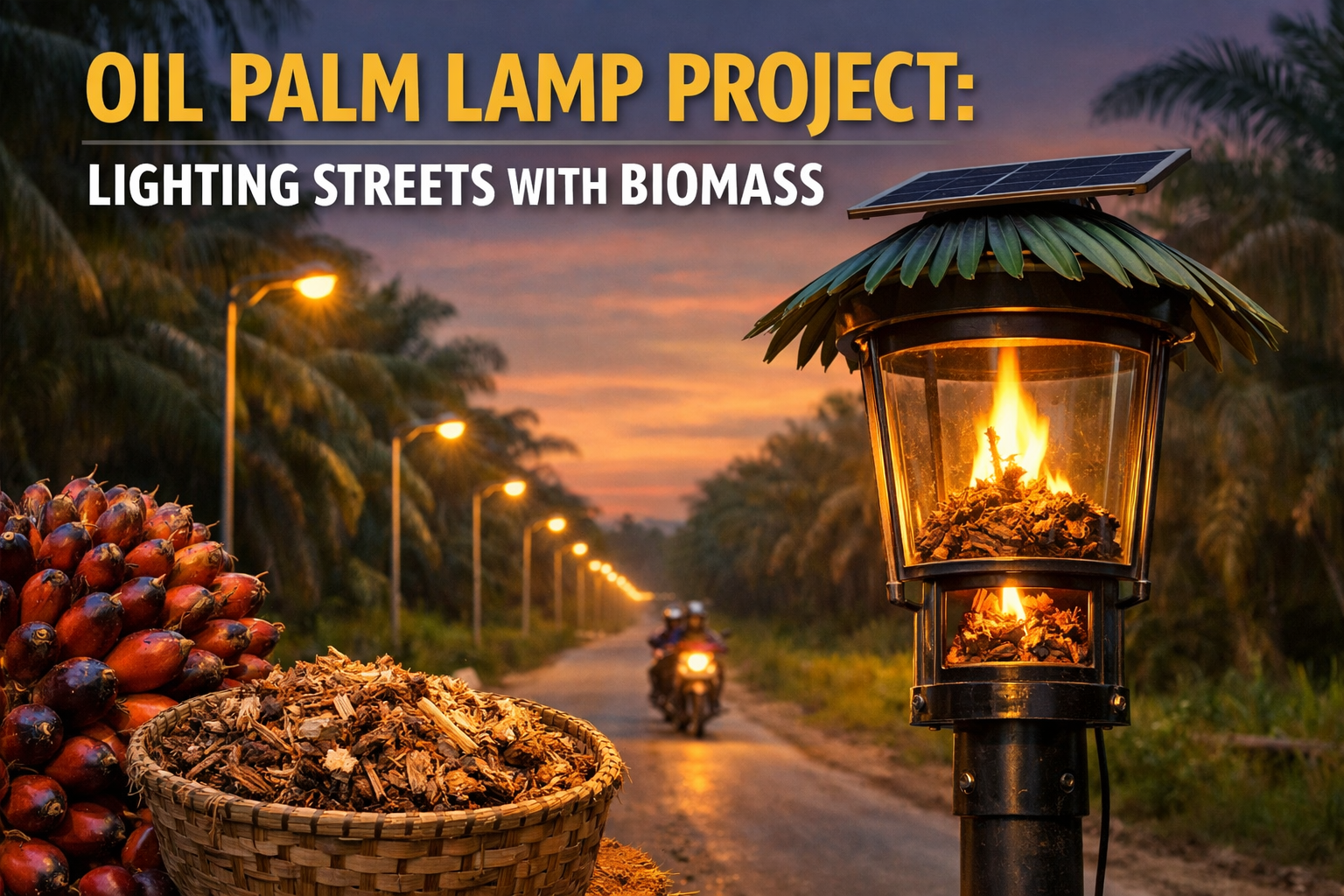
Waste piles in Southeast Asia and West Africa are no longer just environmental burdens; they are the fuel for a brighter night. The oil palm lamp project street lamp oil palm initiative is turning empty fruit bunches and kernel shells into reliable illumination for rural off-grid communities.
The Historical Roots of Palm Oil Lighting
Ancient street lighting in Benin City used palm oil to illuminate public spaces centuries before European cities adopted similar systems.
While many view renewable energy as a modern invention, the concept of a street lamp powered by oil palm dates back to the Kingdom of Benin in present-day Nigeria. Long before London or Paris had organized public lighting, the residents of Benin City strategically placed large metal lamps filled with palm oil along their streets. These lamps used cotton wicks to provide security and ease of movement at night. This historical precedent proves that the current oil palm lamp project street lamp oil palm is not just a trend but a return to a proven, localized resource.
In practice, modern iterations of these projects do not just burn raw oil. Instead, they focus on the circular economy of the plantation. That means using every scrap of the tree—from the trunk to the shells—to generate power. As a result, rural villages that were once invisible on the map after sunset are now finding economic life through the very crops they harvest.
How Biomass Becomes Brightness: The Technology
Modern projects convert solid palm waste into bio-oil or electricity through thermochemical processes like pyrolysis and gasification.
To understand why this works, we need to look at the energy density of the materials. Empty fruit bunches (EFB) and palm kernel shells (PKS) are not just trash; they are concentrated solar energy stored in carbon form. In simple terms, these projects usually follow one of two paths:
1. Direct Combustion/Gasification: The waste is burned or gasified in a central plant to run a turbine, providing electricity for a network of LED street lamps.
2. Bio-oil Pyrolysis: Scientists heat the shells to roughly 450°C to 500°C in an oxygen-free environment. This produces a liquid bio-oil that can be used in specialized combustion lamps or refined for small generators.
Here is why this matters: In regions with heavy monsoon seasons, solar panels often fail to reach full charge due to persistent cloud cover. Biomass, however, is a “dispatchable” energy source. You can burn it whenever you need light, regardless of the weather.
| Feature | Traditional Solar Street Lamp | Oil Palm Biomass Lamp |
|---|---|---|
| Energy Source | Sunlight (Intermittent) | Agricultural Waste (Constant) |
| Reliability | Low during monsoon/winter | High (Independent of weather) |
| Maintenance | Battery replacement every 3-5 years | Regular feedstock collection required |
| Economic Impact | Imported technology | Supports local plantation jobs |
Building an Oil Palm Lamp Project: A Step-by-Step Guide
Implementing a local street lamp project requires a reliable feedstock supply chain and a robust thermochemical conversion unit.
If you want to move the needle on rural electrification, follow this logical flow to establish a pilot project.
Step 1: Feedstock Mapping
First, calculate the volume of waste generated by the local mill. For every ton of crude palm oil produced, there are nearly four tons of biomass waste. You need a steady flow of kernel shells or empty fruit bunches to keep the lamps glowing. Let’s be honest: if the mill is too far away, the transport costs will kill the project before it starts.
Step 2: Selection of Conversion Method
Choose between a centralized micro-grid or individual liquid-fuel lamps. For a **street lamp oil palm** project, a centralized gasification plant is often more efficient. This setup converts the shells into a synthetic gas (syngas) that powers a 10 kW or 100 kW generator, feeding a line of high-efficiency LED poles.
Step 3: Installation of Smart Poles
Use “self-cleaning” technology for the lamp housings. Research shows that dust and organic debris from plantations can clog standard fixtures. Modern projects now use bio-plastic housings made from the palm waste itself, paired with hydrophobic coatings that repel the sticky residue common in tropical environments.
Step 4: Community Training
Maintenance is the graveyard of good intentions. Local workers must be trained to handle the gasification units and clean the LED sensors. Without a local “ownership” model, the hardware will likely sit idle within two years.
The Pivot: The Hidden Truth About “Free” Energy
The biggest mistake in these projects is assuming that agricultural waste is free and easy to manage.
Most experts praise the oil palm lamp project street lamp oil palm as a miracle of circularity. But here is a reality check: biomass is “heavy” energy. Unlike a solar panel that sits silently on a pole, a biomass system requires a heartbeat. You have to harvest it, dry it, process it, and feed it.
In practice, the “waste” actually has a market value. In Malaysia and Indonesia, kernel shells are already sold to the cement and steel industries as fuel. This means your street lamp project is actually competing with global commodity markets. To make a project succeed, you must secure “waste-at-source” agreements with smallholder farmers who don’t have the logistics to sell to big industry. The true value isn’t the “free” fuel—it’s the avoidance of the massive costs associated with extending the national electrical grid into deep jungle terrain.
Another counter-intuitive insight is the “monsoon paradox.” Solar lamps fail when it rains, which is exactly when visibility is most needed for safety. The palm oil lamp project thrives during these periods because the harvest is active, and the fuel supply is peaking just as the sun disappears.
Future Outlook for Integrated Lighting
Integrating IoT sensors with palm-powered micro-grids will allow villages to manage energy use based on real-time activity.
The next phase involves smart sensors. Instead of the lamps burning at 100% all night, they can dim to 10% until a pedestrian or vehicle is detected. This stretches the bio-fuel supply significantly. For example, a village using a 100 kW gasification plant could power 500 street lamps for three days on just a single truckload of kernel shells if smart dimming is applied.
Furthermore, we are seeing a shift toward “carbon-negative” lighting. By turning the palm waste into biochar during the gasification process, the project doesn’t just provide light; it creates a high-value fertilizer that can be returned to the soil. This creates a loop where the lamp literally feeds the tree that provides the oil.
Frequently Asked Questions
Is palm oil actually used in the street lamps?
In most modern projects, the raw oil is too valuable to burn. Instead, the project uses the “leftovers”—the shells and fruit bunches—to create electricity or bio-oil. However, some DIY projects do use filtered, used cooking oil (UCO) as a fuel for simple wick-based safety lamps.
How many houses can one oil palm lamp project support?
A standard 100 kW micro-grid powered by palm waste can support approximately 200 high-intensity street lamps and provide basic evening power for 50-70 rural homes.
What is the biggest challenge to scaling these projects?
The primary hurdle is the moisture content of the biomass. Empty fruit bunches are very wet when first harvested. If they aren’t dried properly before gasification, the system will produce heavy smoke and very little energy.
Are these lamps better than solar lamps?
They are complementary. Solar is easier to install on a single pole, but palm biomass projects are far more reliable for entire villages during the 4-5 months of the rainy season when solar output drops by 60% or more.
The oil palm lamp project street lamp oil palm represents a shift away from imported, fragile technology toward local, resilient power. By looking back at the history of places like Benin City and combining it with modern chemical engineering, we can ensure that the “waste” of today becomes the safety and security of tomorrow.