





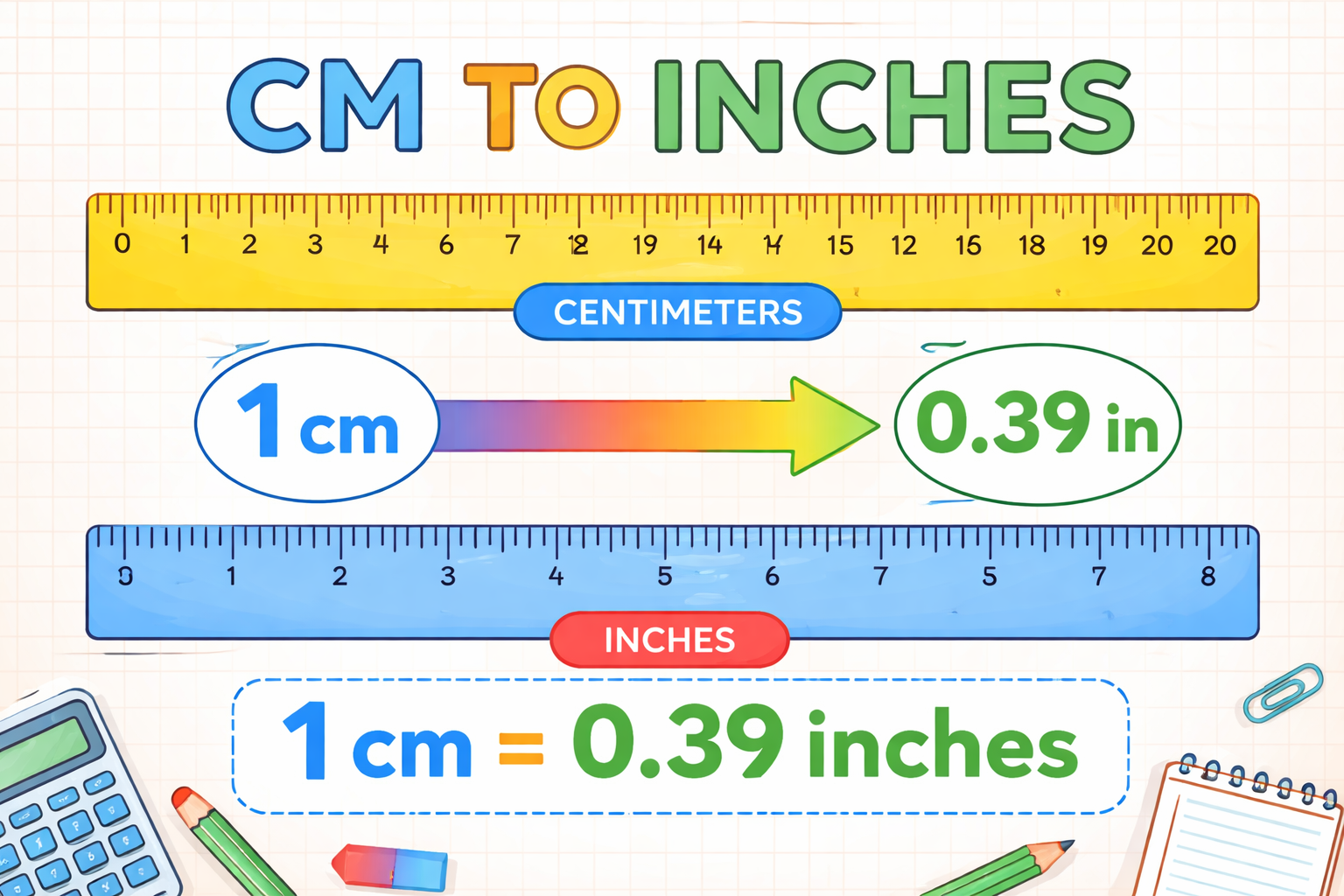
To convert cm to inches accurately, you simply divide the centimeter value by 2.54. This specific number is the global standard, making one inch exactly equal to 25.4 millimeters.
The Core Math of CM to Inches
To find the inch equivalent of any centimeter measurement, divide the total centimeters by 2.54 or multiply by 0.3937.
In practice, the conversion remains one of the most common math tasks for anyone working across international borders. Most of the world uses the metric system, yet the imperial inch persists in specific industries. If you have 10 cm and need the inch value, the math looks like this: 10 / 2.54 = 3.937 inches.
If you prefer multiplication, you can use the factor 0.3937. This number is the reciprocal of 2.54. While it looks messy, it helps when you don’t have a calculator handy. For most daily tasks, like checking a waist size or measuring a box for shipping, rounding to 0.4 works well enough. But if you are building a cabinet or designing a part for a car, those extra decimals matter.
| Centimeters (cm) | Inches (in) – Rounded | Inches (in) – Exact |
|---|---|---|
| 1 cm | 0.39 in | 0.393701 in |
| 5 cm | 1.97 in | 1.968504 in |
| 10 cm | 3.94 in | 3.937008 in |
| 25 cm | 9.84 in | 9.842520 in |
| 30 cm | 11.81 in | 11.811024 in |
| 100 cm (1m) | 39.37 in | 39.370079 in |
The Mental Math Shortcut: The 40% Rule
You can quickly estimate inches by multiplying the centimeter value by 4 and then moving the decimal point one place to the left.
Let’s be honest: nobody wants to divide by 2.54 in their head while standing in a hardware store. Here is a trick that gets you within 1.5% of the correct answer. Think of it as the “40% rule” because 0.4 is very close to the true conversion factor of 0.3937.
For example, if you see a 50 cm shelf, multiply 50 by 4. You get 200. Now, move the decimal one spot to the left to get 20. The actual answer is 19.68 inches. Being off by a third of an inch is usually fine for a rough estimate. It helps you decide if a piece of furniture will fit through a door or if a pair of jeans is roughly the right size.
Another way to do this is to divide by 10 and then multiply by 4. If you have 80 cm, dividing by 10 gives you 8. Multiply by 4, and you get 32. The real answer is 31.49. Again, this is close enough for casual conversation. If you need to be precise, use a calculator. Simple as that.
The 1959 Secret: Why the Inch is Actually Metric
The modern inch is no longer based on physical objects or grains of barley, but is defined as exactly 2.54 centimeters.
Here is the “Hidden Truth” that most people miss: the inch is basically a metric unit in disguise. Before 1959, the United States, the United Kingdom, and Canada all had slightly different definitions of an inch. While the differences were tiny, they caused huge headaches in high-precision manufacturing during World War II. Parts made in London didn’t always fit machines built in New York.
As a result, these nations signed the International Yard and Pound Agreement in 1959. They decided to tie the inch directly to the meter. They didn’t just pick a random number; they chose 2.54 because it was the most common “middle ground” between the varying standards.
This means that every time you measure something in inches today, you are technically using a subdivision of the metric system. The inch isn’t some ancient, mystical length anymore. It is a strictly controlled scientific value defined by the speed of light. In simple terms, the “imperial” system is just a different way of skinning the metric cat.
The Screen Size Trap: Marketing vs. Reality
Electronics manufacturers use inches for screen diagonals even in metric countries because the numbers sound better for marketing purposes.
Have you ever wondered why someone in France or Japan buys a “55-inch” television instead of a “140-centimeter” one? It isn’t just because Americans dominate the tech industry. It is about how the human brain processes numbers.
In the early days of television, the United States was the primary market. Screen sizes were measured diagonally to make them sound larger than they were. Over time, “55 inches” became a standard category. Retailers found that consumers preferred the familiar, smaller numbers of the inch system for branding.
In practice, a “55-inch” screen isn’t actually 55 inches of viewable space in many cases. Bezel sizes and manufacturing tolerances mean the actual glass might be slightly smaller. Plus, converting that diagonal to the width and height of the TV is where things get tricky. A 16:9 aspect ratio means a 55-inch diagonal results in a width of roughly 121 cm. If you only measure the diagonal, you might buy a TV that doesn’t actually fit on your wall. Always check the full dimensions in cm before you buy.
Precision Engineering and the “Two Millionths” Error
Small rounding errors in unit conversion can lead to catastrophic failures in aerospace and medical engineering.
Think of unit conversion like a game of telephone. Every time you round a decimal, you lose a tiny bit of truth. In 1999, NASA lost the Mars Climate Orbiter because one team used metric units while another used imperial units. That mistake cost $125 million.
To be exact, the difference between using 0.39 and 0.3937 is roughly 1%. That sounds small. But if you are building a bridge that is 100 meters long, a 1% error means you are off by a full meter. In the medical field, a tiny error in converting a patient’s height or weight from cm to inches can lead to the wrong dosage of anesthesia.
For high-stakes work, experts never use shortcuts. They stay in one system from the start of the project to the end. If they must convert, they use the full “2.54” factor and keep the decimals long until the very last step. This prevents “rounding creep,” where errors grow bigger as they pass through more equations.
Frequently Asked Questions
Is 1 inch exactly 2.54 cm?
Yes, since the 1959 international agreement, the inch is defined as exactly 2.54 centimeters. There is no longer any variation or approximation in the legal definition.
How do I convert cm to inches on a calculator?
Type in your centimeter value and press the divide (/) key, then 2.54, followed by the equals (=) sign. For example, 100 divided by 2.54 gives you 39.37007.
Why do some people use 0.39 instead of 2.54?
Multiplying by 0.39 is often faster than dividing by 2.54, but it is less accurate. Using 0.39 is an approximation that works for daily life but fails in engineering or science.
How many cm are in a foot?
There are exactly 30.48 centimeters in one foot. This is found by multiplying 12 inches by 2.54.
The shift between cm and inches is more than just math; it is a bridge between different ways of seeing the world. Whether you are estimating a rug size or designing a satellite, knowing that 2.54 is the magic number ensures you stay on the right track.