





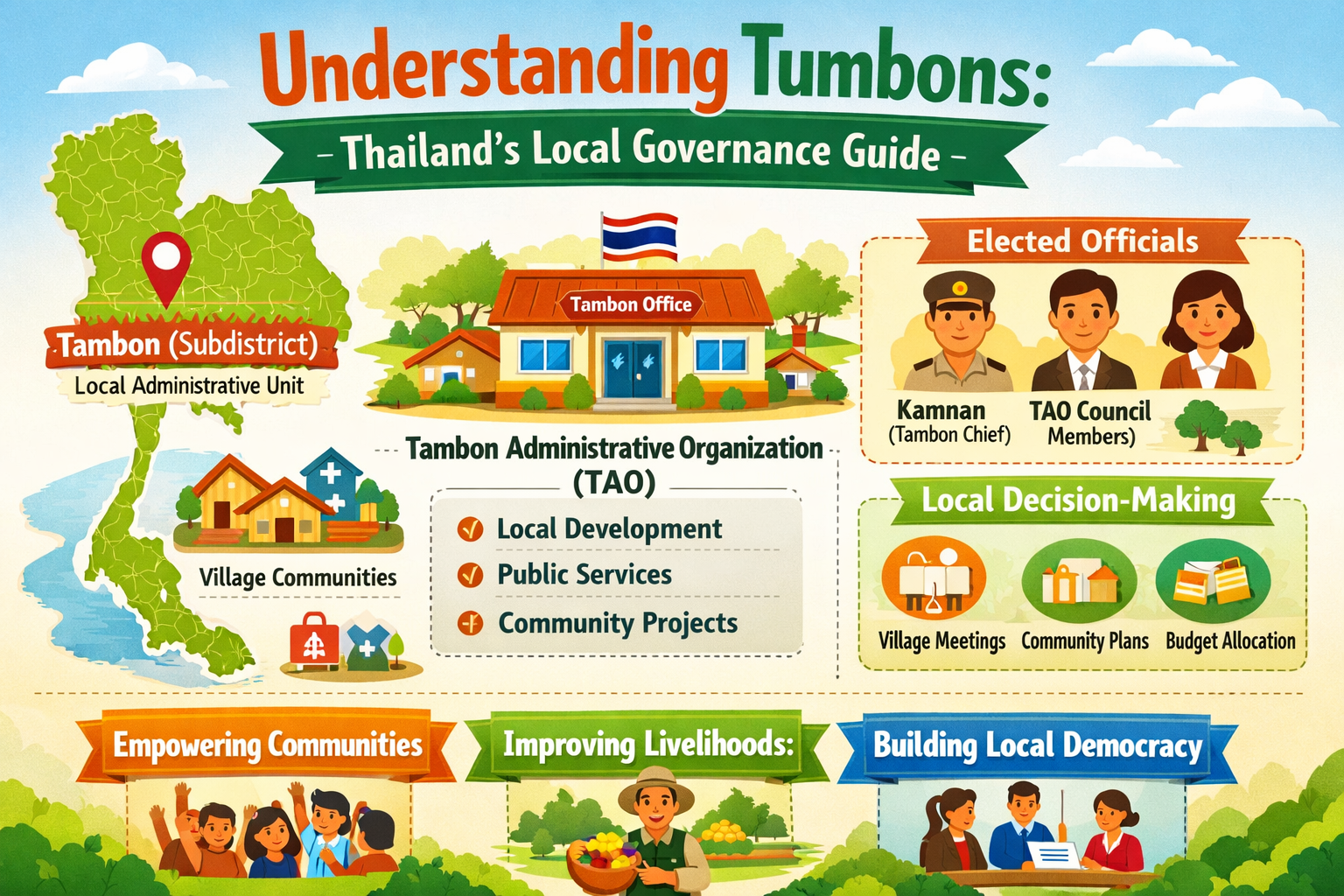
Most travelers and investors see Thailand as a collection of bright city lights or sandy beaches, but the real machinery of the country runs on tumbons. If you look at an address outside of Bangkok, you will see this word appearing as the final local marker before the village level, acting as the primary gear in the kingdom’s administrative engine.
What Exactly is a Tumbon?
A tumbon is a third-tier administrative subdivision in Thailand that functions as a sub-district, bridging the gap between individual villages and larger district authorities.
In simple terms, think of a tumbon as a neighborhood on steroids. While a province is like a state and a district is like a county, the tumbon is the smallest unit with its own formal budget and legislative council. There are roughly 7,255 of these units across the country. Each one consists of several villages, known as muban.
The structure is not just a line on a map. It is the level where the government actually meets the people. For example, if a rural road needs paving or a local school needs a new roof, the request does not go to Bangkok first. It starts at the tumbon level.
| Level (Thai Name) | English Equivalent | Primary Leader |
|---|---|---|
| Changwat | Province | Governor |
| Amphoe | District | District Officer (Nai Amphoe) |
| Tumbon | Sub-district | Kamnan / TAO President |
| Muban | Village | Village Headman (Phu Yai Ban) |
The Real Power: The Tambon Administrative Organization (TAO)
The TAO, or Or Bor Tor, is the locally elected body responsible for managing infrastructure, public services, and development budgets within a tumbon.
Let’s be honest: the TAO is the village elder with a spreadsheet. Before 1994, power was mostly centralized. That changed when the government decided to give more control to local communities. Now, the TAO has a legislative council and an executive branch.
They handle the “unsexy” but vital tasks that keep a community running. This includes:
- Trash collection and waste management.
- Maintenance of local “Soi” (side roads) and waterways.
- Managing local health centers and child development hubs.
- Issuing small-scale building permits.
In practice, the TAO receives a mix of locally collected taxes and grants from the central government. This gives them a level of autonomy that was unheard of forty years ago. As a result, the personality and efficiency of a tumbon can vary wildly depending on who is elected to the council.
The OTOP Connection: Economy at the Sub-district Level
The One Tambon One Product (OTOP) initiative is a national program that encourages each tumbon to develop and market a unique local product to boost community income.
Here is why this matters: the OTOP program turned tumbons into brands. Inspired by a Japanese model, the Thai government realized that every sub-district had a “hidden gem”—maybe a specific type of hand-woven silk, a unique spicy paste, or wood carvings.
By labeling these as OTOP products, the government helps with packaging, quality control, and export. When you walk through a Thai airport and see high-end spa products or traditional snacks, you are often looking at the fruit of the OTOP system. This program does more than just sell trinkets; it creates jobs so that young people do not have to move to Bangkok to find work.
The Five-Star Grading System
OTOP products are not all equal. They are graded by a committee of experts:
- 5 Stars: Top-tier quality, ready for international export.
- 3-4 Stars: High quality, sold in major malls and national fairs.
- 1-2 Stars: Local favorites that need more development in packaging or shelf life.
The Pivot: The Hidden Truth About Local vs. Central Power
Many people assume that because Thailand has tumbons and elected local councils, the country is fully decentralized. That is a myth. In reality, there is a constant “tug-of-war” between the local TAO and the Ministry of Interior.
Here is the truth: while the TAO is elected, the Kamnan (the traditional head of the tumbon) is often seen as the representative of the central government. This creates a dual-power system. You have the “modern” elected officials and the “traditional” leadership. If you want to get something done in a rural area, you often need both on your side.
As a result, progress can be slow. A TAO might want to build a new bridge, but if the central government’s provincial office does not approve the land use, the project sits in limbo. For the savvy investor or researcher, understanding this friction is the key to knowing why some areas thrive while others remain stuck in the past.
Practical Guide: Navigating Tumbons for Expats and Investors
For non-Thais, interacting with a tumbon is most common when applying for building permits or paying local land and house taxes.
If you are planning to build a house on leased land in a rural area, you will spend a lot of time at the TAO office. You won’t be dealing with a massive bureaucracy in a skyscraper; you’ll be sitting in a small office, likely drinking tea with local officials.
How to Get a Building Permit in a Tumbon
The process is surprisingly logical, but it requires patience.
- Preparation: You need blue-prints signed by a licensed Thai architect and engineer.
- Land Proof: You must provide a copy of the land title deed (Chanote) and, if you are a foreigner, your lease agreement.
- Submission: Take these to the TAO’s engineering department. They will check if the building violates local height or environmental codes.
- Inspection: An official may visit the site to ensure the land isn’t part of a protected forest or public waterway.
That means you should always check the local “vibe” before buying or leasing. Some tumbons are very pro-development and will help you navigate the paperwork. Others are protective of their local culture and may be more restrictive.
The Future of the Sub-district
As Thailand pushes toward its “Thailand 4.0” digital economy goals, tumbons are being forced to modernize. We are seeing more TAOs using apps for residents to report potholes or pay taxes. However, the soul of the system remains the same: it is about community.
Whether it is a fisherman in a coastal tumbon or a rice farmer in the north, the local sub-district office remains the place where their voice is loudest. It is a system that has survived coups, economic crashes, and a global pandemic because it is built on the most basic human unit: the neighbor.
Frequently Asked Questions
1. Is a “Tambon” the same as a “Tumbon”?
Yes. “Tambon” is the official government transliteration, while “tumbon” or “tumbol” are common phonetic spellings used by English speakers. They all refer to the same sub-district level of administration.
2. How many villages are usually in one tumbon?
On average, a tumbon consists of 10 to 15 villages (mubans), though this can vary based on population density. In mountainous regions, a tumbon might cover a massive area with only a few small villages.
3. Can a foreigner vote in tumbon elections?
No. Only Thai citizens who are registered residents of that specific tumbon can vote for the TAO council and president. However, foreigners who own businesses or lease land are still required to follow the regulations set by the TAO.
4. Where can I find OTOP products?
The best places are the “OTOP City” fairs held annually at the IMPACT Arena in Bangkok, or specialized OTOP centers located within each province. Many tumbons also have small roadside shops showcasing their specific local specialty.
If you want to move the needle on your understanding of Thai culture, stop looking at the provinces and start looking at the tumbons. That is where the real life happens.