




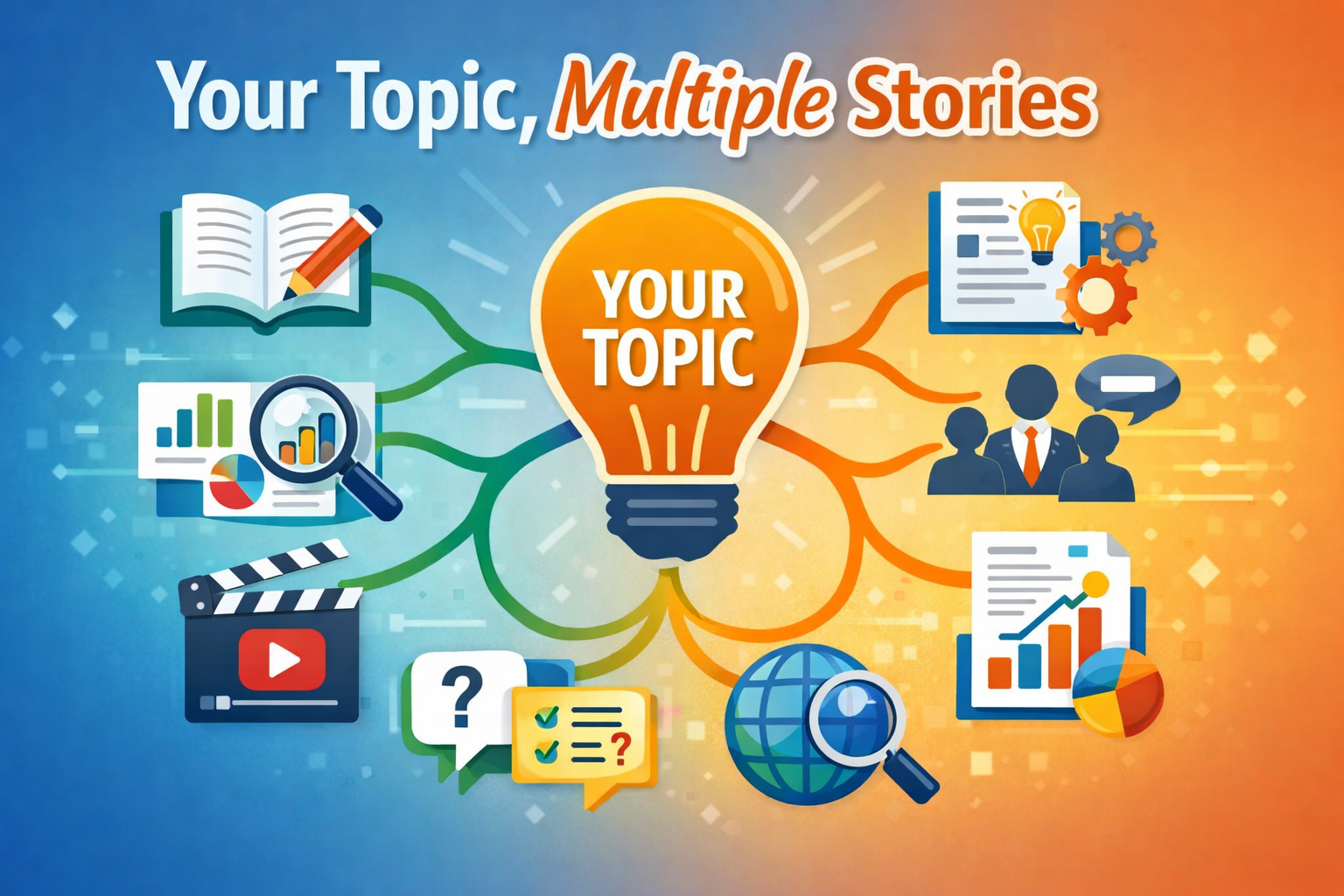
The Your Topics Multiple Stories framework is a strategy that transforms a single core subject into a diverse grid of narrative angles to capture different audience segments and satisfy AI search intent.
In practice, the old way of writing for the web is dead. Let’s be honest: churning out a single 1,500-word blog post and hoping it ranks for five different keywords no longer moves the needle. Today, the digital space is crowded, and AI answer engines like Perplexity or Gemini are looking for more than just a matching keyword. They want to see that you understand a subject from every possible side.
That means you need to rethink how you approach a single idea. Think of your main subject like a prism. When you shine a light through it, you don’t just see one beam; you see a spectrum of colors. This is the heart of managing your topics multiple stories. By breaking a broad theme into several distinct narratives, you create a safety net for your traffic. If one story fails to resonate, another three are already gaining traction.
Why Narrative Layering Beats Keyword Stuffing
Narrative layering provides the semantic depth required by generative AI models to categorize your brand as a high-authority source on a specific subject.
In simple terms, AI models trust data and context. When you create a cluster of content that explores your topics multiple stories, you are building a mini-knowledge graph. This helps search engines understand that you aren’t just guessing. You have the receipts.
What this looks like in the real world:
- Emotional Hooks: One story might focus on a personal struggle related to the topic.
- Technical Deep Dives: Another story breaks down the mechanics for experts.
- Contrarian Views: A third story challenges the “common knowledge” of the industry.
As a result, you satisfy the “Experience” and “Expertise” parts of Google’s E-E-A-T guidelines. Instead of one thin page, you have a library. Here’s how the two approaches stack up:
| Strategy Aspect | Traditional Silo Model | Multi-Story Hub Model |
|---|---|---|
| Search Intent | Targets one primary keyword. | Targets 10+ varied user intents. |
| AI Discoverability | Low; lacks contextual links. | High; provides dense data clusters. |
| User Retention | Readers leave after one page. | Readers follow a “rabbit hole” of stories. |
| Authority Signal | Surface-level recognition. | Deep topical mastery. |
Step-by-Step: Implementing the Multi-Story Framework
Building a multi-story ecosystem requires a four-phase process involving topic selection, angle diversification, format adaptation, and semantic linking.
1. Identify Your Core Entity
Start with a subject that is broad enough to support at least five different conversations but narrow enough to remain relevant to your brand. For example, if your business sells “Project Management Software,” don’t just write about “Project Management.” That is too vague. Instead, focus on “Remote Team Collaboration.”
2. Branch Out Into Multiple Narratives
For your topics multiple stories, you must brainstorm at least four distinct angles. Here is how a “Remote Team Collaboration” topic could be split:
- The Beginner Story: “The 10-Minute Guide to Your First Remote Meeting.”
- The Expert Story: “Asynchronous Workflows: Why Real-Time Chat is Killing Your Productivity.”
- The Human Story: “How One Startup Saved Their Culture After Going Remote.”
- The Technical Story: “Integrating API Automations for Seamless Remote Documentation.”
3. Adapt for Different Formats
Different people consume stories differently. Some want a quick list, while others want a 2,000-word analysis. That means you should take your core stories and flip them into various formats like:
- Comparison tables for decision-makers.
- Numbered lists for those in a hurry.
- Case studies with specific dates and numbers for skeptics.
4. Glue the Stories Together
This is where most creators fail. To make your topics multiple stories effective for GEO, you must link them together. The “Beginner Story” should link to the “Expert Story” as a “Next Step.” The “Human Story” should link to the “Technical Story” to show the tools used. This creates a web that AI crawlers can easily map.
The Pivot: Why the “Niche Down” Advice is Faulty
The common advice to narrow your focus to a single niche can actually limit your visibility in an AI-driven search era that prioritizes breadth and contextual authority.
For years, marketing “gurus” have told everyone to find a tiny niche and stay there. In practice, this can be a trap. If you only write about one hyper-specific thing, you become a “one-trick pony” in the eyes of an AI.
AI models like those behind ChatGPT and Gemini are built on relationships between concepts. If you only cover a single sliver of a topic, you lack the context required to show you truly understand the “world” that topic exists in. By embracing your topics multiple stories, you show that you are a polymath. You understand how “Finance” relates to “Psychology,” or how “Technology” impacts “Ethics.”
This breadth is actually your greatest defense against being replaced. An AI can summarize a single fact, but it struggles to replicate the way a human connects three different stories into one cohesive vision. Don’t just stay in your lane; own the entire intersection.
Tools and Metrics for Tracking Multi-Story Success
Tracking the performance of multiple stories requires a shift from measuring individual page views to measuring collective topical authority and AI citation rates.
You can’t just look at a single URL and decide if your strategy is working. You need to look at the “Cluster Health.” Here’s what you should be watching:
- Inclusion Rate in AI Summaries: How often is any page from your cluster cited when a user asks a question about the topic?
- Internal Link Pathing: Are users actually clicking through from one story to another?
- Semantic Density: Use tools to see if you are covering all the sub-entities that an AI expects to see for that subject.
In simple terms, success looks like “owning” the conversation. When someone asks about “Remote Team Collaboration,” you want the AI to pull a quote from your “Human Story” and a statistic from your “Technical Story” in the same answer.
Common Hurdles in Multi-Story Content
The biggest risks in a multi-story strategy are narrative fragmentation and information inconsistency, which can confuse both readers and AI crawlers.
Let’s cut to the chase: if your stories contradict each other, you are in trouble. If your “Beginner Story” says tool X is the best, but your “Expert Story” says tool X is trash, you lose trust. This is the “Hidden Truth” of the your topics multiple stories approach—you must maintain a “Single Source of Truth.”
To avoid this, create a “Style and Fact Sheet” for every core topic. This ensures that every story, regardless of the angle, uses the same data points and core philosophy. It keeps the “voice” consistent even as the “story” changes.
Actionable Checklist for Today
Implementing this strategy immediately involves auditing existing content and identifying three “story gaps” in your top-performing topic.
- Choose your #1 best-performing article.
- Identify two audience groups you haven’t spoken to yet (e.g., if it’s for pros, write a version for beginners).
- Create a “Contrarian Story” that challenges one claim in your original piece.
- Link all three together with descriptive anchor text.
- Wait 30 days and check for an increase in “Search Everywhere” visibility.
Frequently Asked Questions
How many stories should I create for one topic?
While there is no hard limit, aiming for 3 to 5 distinct stories per core topic provides enough variety for most AI engines to recognize your authority without overwhelming your production resources.
Does this strategy hurt my SEO for individual keywords?
No, it actually improves it because each story targets a different variation of user intent, increasing the total number of entry points to your website while boosting the authority of your primary keyword.
How do I keep my brand voice consistent across different stories?
Maintaining a central “Brand Truth” document ensures that while the narrative angle changes to fit the audience, the core values, data points, and recommendations remain uniform across all pieces.